-
 Crazygames 2024
-
 Feminization Games
-
 FNAF Unblocked
-
 Play With Friends
-
 Geometry Dash Unblocked
-
 Google Sites Unblocked
-
 GTA Unblocked
-
 Horror Unblocked
-
 Minecraft Unblocked
-
 1v1.LOL
-
 2 Player
-
 ABCya
ABCya
-
 Action
-
 Adventure
-
 Amanda The Adventurer
-
 Among Us
-
 Backrooms
-
 Baldi’s Basics
-
 Bamboozle
-
 Barbie
-
 BeamNG Drive
-
 Best
Best
-
 BitLife
-
 Bleach vs Naruto
-
 Chess
Chess
-
 Chilla's Art
-
 Choo Choo Charles
-
 Creepypasta
-
 Doraemon
-
 DOS
DOS
-
 Driving
-
 Easymath
-
 Evil Nun
-
 Fancade
-
 Farming Simulator
-
 Fighting
-
 FNaF
FNaF
-
 Friday Night Funkin
-
 Friv
Friv
-
 Gacha Life
-
 For Boys
-
 For Girls
-
 For Kids
-
 Garry’s Mod
-
 Garten of Banban
-
 Genshin Impact
-
 Goat Simulator
-
 Granny
-
 GTA
GTA
-
 Happy Wheels
-
 Hello Neighbor
-
 Horror
-
 Hungry Shark
-
 Incredibox
-
 Incredibox Scratch
-
 Indie
Indie
-
 IO Games
-
 Itch.io
-
 Japanese Horror
-
 Jump Force Mugen
-
 Kogama
-
 Lagged
-
 Mahjong
-
 Medical Doctor
-
 Melon Playground
-
 Minecraft
-
 Multiplayer
-
 Multiplayer Unblocked
-
 My Singing Monsters
-
 Nintendo
-
 Old Games
-
 Papa's
-
 PK XD
PK XD
-
 Poki
Poki
-
 Poppy Playtime
-
 Purble Place
-
 Puzzle
-
 Racing
-
 Rainbow Friends
-
 Red Ball
-
 Retro Bowl
-
 Roblox
-
 Sakura School Simulator
-
 Shooting
-
 Skibidi Toilet
-
 Snowmobile
-
 Solar Smash
-
 Sports
-
 Stickman
-
 Summertime Saga
-
 Supermarket Simulator
-
 Survival
-
 Talking Angela
-
 Talking Ben
-
 Talking Tom
-
 That's not my Neighbor
-
 The Amazing Digital Circus
-
 The Baby In Yellow
-
 Play The Pizza Edition Games Online
-
 The Sims
-
 Toca Boca
-
 Toca Life
-
 Touchdown
-
 Unblocked 6969
-
 Play Wobbly Life Games
-
 Retro Unblocked
-
 Sprunki Games
-
 Sprunki Wenda Treatment Games
-
 Stickman Unblocked
-
 Suika Games Online
-
 Unblocked 2024
-
 Unblocked Games 66
-
 Unblocked Games 76
-
 Unblocked Games 77
-
 Unblocked Games at School
-
 Unblocked Games Premium
-
 Unblocked Games World





Advertisement
Squid Games Simulator
Advertisement
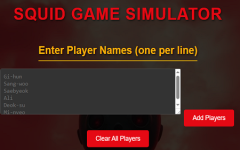
Built around elimination-driven gameplay, Squid Games Simulator recreates a structured survival format where players advance through successive competitive rounds. The experience focuses on rule enforcement, reaction timing, and performance-based outcomes rather than narrative progression. Each session presents a sequence of challenges governed by distinct mechanical constraints. Advancement depends on satisfying round conditions, while failure typically results in immediate elimination. The simulator format emphasizes repetition, adaptation, and rule comprehension.
Challenge Logic And Session Flow
The gameplay structure of Squid Games Simulator is organized into discrete rounds that operate under specific rules. These rounds introduce tasks that test movement accuracy, timing precision, or situational responses. Early challenges often establish fundamental mechanics, while later rounds tighten constraints and increase error penalties. The absence of persistent progression systems shifts emphasis toward session-based survival. Players repeatedly attempt rounds, refining strategies and adjusting behavior based on prior outcomes.
Mechanical Constraints And Difficulty Scaling
Difficulty progression in Squid Games Simulator is primarily achieved through mechanical limitations rather than expanded control systems. Movement restrictions, reaction windows, and rule conditions define challenge complexity. Later rounds may require stricter timing accuracy or introduce environmental hazards that modify player decisions. This scaling model ensures that progression remains dependent on rule mastery and situational awareness.
Core gameplay systems typically include:
- Multi-stage elimination mechanics
- Rule-defined challenge rounds
- Timing and reaction-based tasks
- Session reset progression model
- Variable mechanical constraints
- Performance outcome tracking
These elements collectively shape gameplay pacing.
Decision-Making And Tactical Adaptation
Strategic interaction within Squid Games Simulator centers on evaluating round requirements and minimizing failure risk. Some challenges reward cautious timing, while others require immediate reactions. Players must interpret constraints dynamically, adapting movement and interaction patterns. The design encourages anticipation of rule conditions rather than reliance on reflex speed alone. Consistency becomes a key factor in later stages.
Squid Games Simulator operates as a mechanics-focused survival environment where elimination logic drives player engagement. The gameplay loop emphasizes repeated attempts, performance evaluation, and tactical refinement. Over time, players focus on optimizing responses, understanding constraint patterns, and improving survival efficiency. The simulator framework prioritizes rule-driven tension and structured progression across evolving challenge sequences.