-
 Crazygames 2024
-
 Feminization Games
-
 FNAF Unblocked
-
 Play With Friends
-
 Geometry Dash Unblocked
-
 Google Sites Unblocked
-
 GTA Unblocked
-
 Horror Unblocked
-
 Minecraft Unblocked
-
 1v1.LOL
-
 2 Player
-
 ABCya
ABCya
-
 Action
-
 Adventure
-
 Amanda The Adventurer
-
 Among Us
-
 Backrooms
-
 Baldi’s Basics
-
 Bamboozle
-
 Barbie
-
 BeamNG Drive
-
 Best
Best
-
 BitLife
-
 Bleach vs Naruto
-
 Chess
Chess
-
 Chilla's Art
-
 Choo Choo Charles
-
 Creepypasta
-
 Doraemon
-
 DOS
DOS
-
 Driving
-
 Easymath
-
 Evil Nun
-
 Fancade
-
 Farming Simulator
-
 Fighting
-
 FNaF
FNaF
-
 Friday Night Funkin
-
 Friv
Friv
-
 Gacha Life
-
 For Boys
-
 For Girls
-
 For Kids
-
 Garry’s Mod
-
 Garten of Banban
-
 Genshin Impact
-
 Goat Simulator
-
 Granny
-
 GTA
GTA
-
 Happy Wheels
-
 Hello Neighbor
-
 Horror
-
 Hungry Shark
-
 Incredibox
-
 Incredibox Scratch
-
 Indie
Indie
-
 IO Games
-
 Itch.io
-
 Japanese Horror
-
 Jump Force Mugen
-
 Kogama
-
 Lagged
-
 Mahjong
-
 Medical Doctor
-
 Melon Playground
-
 Minecraft
-
 Multiplayer
-
 Multiplayer Unblocked
-
 My Singing Monsters
-
 Nintendo
-
 Old Games
-
 Papa's
-
 PK XD
PK XD
-
 Poki
Poki
-
 Poppy Playtime
-
 Purble Place
-
 Puzzle
-
 Racing
-
 Rainbow Friends
-
 Red Ball
-
 Retro Bowl
-
 Roblox
-
 Sakura School Simulator
-
 Shooting
-
 Skibidi Toilet
-
 Snowmobile
-
 Solar Smash
-
 Sports
-
 Stickman
-
 Summertime Saga
-
 Supermarket Simulator
-
 Survival
-
 Talking Angela
-
 Talking Ben
-
 Talking Tom
-
 That's not my Neighbor
-
 The Amazing Digital Circus
-
 The Baby In Yellow
-
 Play The Pizza Edition Games Online
-
 The Sims
-
 Toca Boca
-
 Toca Life
-
 Touchdown
-
 Unblocked 6969
-
 Play Wobbly Life Games
-
 Retro Unblocked
-
 Sprunki Games
-
 Sprunki Wenda Treatment Games
-
 Stickman Unblocked
-
 Suika Games Online
-
 Unblocked 2024
-
 Unblocked Games 66
-
 Unblocked Games 76
-
 Unblocked Games 77
-
 Unblocked Games at School
-
 Unblocked Games Premium
-
 Unblocked Games World





Advertisement
Flesh, Blood, & Concrete
Advertisement

Flesh, Blood, & Concrete is a narrative exploration game released on itch.io and built with RPG Maker. The player follows a character named Lera who enters an apartment building after her journey is interrupted by a snowstorm. From the first moments, the game establishes a structure focused on movement and observation rather than challenge. There are no combat encounters, puzzles, or performance metrics. Progress is achieved by navigating the space and engaging with narrative fragments embedded in the environment.
Architectural Progression
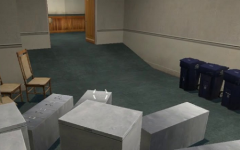
The apartment complex functions as the sole playable location and as the main storytelling device. Floors, hallways, and rooms are connected in a way that encourages continuous movement forward. Early areas appear ordinary, but spatial logic slowly shifts as the player advances. New paths open without explicit explanation, and familiar layouts begin to feel altered. The absence of maps or markers means that progression depends on spatial awareness and willingness to explore rather than following objectives.
Interaction Design
Interaction in Flesh, Blood, & Concrete is intentionally restrained. The player can move freely, inspect objects, and trigger dialogue at specific points. Objects are not tools and cannot be used to solve problems. Instead, they serve as narrative elements that add context or prompt reflection. This keeps interaction consistent across the entire experience and prevents mechanical escalation.
Key interaction elements include:
- Free navigation across multiple floors and rooms
- Object examination that provides short narrative text
- Dialogue sequences triggered by location or progress
- Passive item collection with descriptive function only
- Area transitions activated through exploration
These elements support a steady flow without introducing new systems.
Narrative Assembly
The story is revealed gradually through indirect means. Dialogue with another character inside the building offers limited information, while much of the narrative is conveyed through environmental cues and written descriptions. The game avoids clear exposition, requiring the player to connect fragments on their own. As Lera moves deeper into the building, the environment itself becomes part of the narrative, reflecting changes in tone and meaning rather than presenting direct explanations.
Pacing And Control
Pacing in Flesh, Blood, & Concrete is determined entirely by player movement. There are no timed events, forced sequences, or failure conditions. The player can pause, backtrack, or remain in a space without consequence. This design emphasizes attention and interpretation instead of reaction or efficiency. Progress feels deliberate because each new area follows naturally from exploration.
The game is designed for a single-session playthrough with a clear conclusion reached through spatial advancement. Flesh, Blood, & Concrete uses minimal mechanics to support a focused narrative experience. By removing traditional gameplay pressures, it places full emphasis on environment, structure, and gradual discovery, allowing meaning to emerge through navigation rather than challenge.